
Reimagining the In-House Agency

For years, in-house agencies (IHAs) have been the holy grail of marketing efficiency. They were faster, cheaper, and closer to the brand than relying on external agencies and partners. But today, as budgets tighten and speed-to-market is measured in days, not months, strategy can feel outdated even before launch. And many companies are rethinking the equation: What belongs in-house? What should be outsourced, or automated? And where does AI fit in? 

Market forces from cost-cutting pressures to evolving talent needs are influencing in-house agency structures. At the same time, external factors such as a changing political climate and rapid technological advances mean campaigns must evolve in real time. Generative AI has also transformed how strategy and storytelling come together. And the rise of “vibe marketing,” where campaigns are built around mood, movement, and cultural resonance rather than hard data or demographics, reflects a new creative instinct powered by AI tools. 

Even high-profile internal shops aren’t immune to the shift. Liquid Sunshine, the award-winning in-house agency behind Keurig Dr Pepper, was recently dismantled as they chose to move away from their in-house creative model. And while Mark Zuckerberg predicted that AI will eventually take over agency work, the reality today is far from apocalyptic. Instead, it is ushering in an era of nimble decision-making that blends human creativity with AI-driven insight.

From Consolidated to Connected: How AI Is Rewriting the IHA Playbook 

For many IHAs, capabilities can lag behind ambition: A 2025 Gartner survey found more than a quarter of CMOs have limited or no AI adoption in their marketing campaigns. That gap is forcing teams to make critical choices about how to build, buy, or borrow the technology they need to stay competitive.

Some brands are building proprietary AI systems: A massive technical and financial lift that demands new governance frameworks and training programs. For example, Adobe leverages the tools created for external partners for in-house work. Second Wave, the IHA for Aimbridge Hospitality, created closed-source, proprietary AI platforms that allow new hotels and projects to autonomously jumpstart brand-building

Other IHAs are partnering with external agencies that have their own AI infrastructure, a choice that can unlock efficiency but sometimes means ceding a bit of control. U.S. Bank, for example, has developed a hybrid approach, using agency Supergood for heavier lifts, while using their own in-house systems for everyday marketing efforts.  

Either way, workflows are being rewritten. The once-clear boundaries between internal and external teams are blurring, requiring tighter communication, shared platforms, and co-created content pipelines. Unilever’s Beauty AI Studio is a perfect example. “We used to send briefs off and get content back. Now it’s this agile, iterative approach,” Selina Sykes, Global VP and Head of Marketing Transformation for Beauty and Wellbeing, told Digiday about how the beauty brand is shifting.  

Turning Pressure into Possibility 

In-house agencies are at an inflection point. The pressure to do more with less can feel relentless. But it’s also sparking innovation. Constraints are forcing teams to rethink legacy structures, pilot new workflows, and uncover efficiencies that create both creative and budgetary flex. 

The first move is clarity. Map how work actually gets done … not how it’s supposed to get done. Identify bottlenecks, overlapping roles, and where technology is underused or skills are lagging. A fresh set of eyes can help: many brands are bringing in consultancies or external auditors to benchmark performance and uncover hidden inefficiencies. 

From there, experiment in controlled environments. Pilot hybrid workflows that combine AI-assisted production with human oversight. Start with lower-stakes campaigns to test new processes, clarify ownership, and measure output. The goal isn’t to do everything internally, but to decide what belongs in-house, what can be automated, and what’s best handled by trusted partners.

Upskilling is critical. As creative, marketing, and tech roles continue to converge, AI fluency and cross-functional collaboration are becoming baseline expectations. Teams that invest in training now will be better positioned to lead, not follow, as tools and platforms evolve. Just as important is finding the right partners who complement internal strengths, bring specialized expertise, and can flex as priorities shift. 

If projects stall in approvals, campaigns feel repetitive, or AI tools sit idle, those are signs it’s time for your IHA to recalibrate, not rebuild. The strongest IHAs see transformation as a continuous cycle of testing, learning, and scaling what works. Because at this turning point, the real advantage isn’t size or spendIt’s the ability to stay flexible, adapt fast, and turn every constraint into a catalyst for better work. 

The Future of IHAs is Human 

The next era of in-house work isn’t defined by automation. It’s defined by alignmentbetween people and platforms, insight and execution, creativity and technology. Because while AI may be able to execute campaigns, it’s people who decide which campaigns matter. Teams are the connective tissue that allow brands to pivot, sense cultural shifts, and build authentic identity in ways only humans can. 

Creative Circle helps brands build flexible, future-ready teams that blend human expertise with emerging technology. Whether you’re reimagining your IHA or exploring AI-enhanced workflows, we can help you find the right mix of people, partners, and potential.  

About the Author: Anna Davies is a Creative Circle freelancer who specializes in personal finance, investing, fintech, and startups. She has worked with WeWork, Happy Money, and Haven Life —plus Fortune 500 companies such as Goldman Sachs, American Express, Citi, and Chase. Davies has also collaborated and ghostwritten for multiple New York Times bestsellers. 

It starts small: A design tweak here, a pivot suggested in a standup, a “quick favor” requested with a smile. Suddenly, your carefully scoped project has ballooned—without a matching bump in budget or bandwidth. 

This is scope creep: when the work expands beyond the original agreement, often without formal acknowledgment or compensation. It’s common, it can be costly, and if you’re not actively managing it, it can strain relationships, burn out your team, wreck your timeline — and potentially damage the partnership.  

“Scope creep happens at the expense of other work and therefore the quality suffers, leading to unhappy clients,” explains Lauren, a Creative Circle freelancer and Project Manager since 2021. And when you’re constantly reacting, you miss the chance to plan strategically, which may cost you more in the long run. 

The following strategies can help prevent scope creep from compromising a project’s success. 

Understanding the Issue: Why Scope Creep Happens 

Scope creep happens for a variety of reasons, but, in Lauren’s experience, it tends to occur due to “some combination of the following: poor documentation, bad communication, a lack of organization, or inability to politely draw a line with the client and hold everyone accountable.”  

Scope creep can also stem from the natural evolution of a creative project mid-workflow such as budget shifts, leadership weighs in, or current events and consumer sentiment demand a quick pivot. These external factors could result in a client asking for more revisions, inclusion of new messaging, or shifting secondary assets into the spotlight. 

Recognizing and Naming Scope Creep 

For creative agencies, saying yes to emerging requests, or volunteering to support your client when their team’s underwater, may feel like the right move. But over time, it creates confusion about roles, deliverables, and expectations. It also puts pressure on team members who have to absorb that extra work, often without acknowledgement. 

How Agency Teams Can Help Clients Stay on Track 

  • Start with clarity. A rock-solid brief and clearly defined deliverables should be your North Star. It can also be helpful to proactively discuss change orders, so your client can feel empowered to shift and expand the scope mid-project. And trust your gut: If the work feels like it’s veering off the map, it probably is.
  • Build in checkpoints. “Weekly meetings or status updates can be used to course-correct early,” says Lauren.
  • Document everything. Even quick-turn pivots need to be captured in writing, reminds Lauren.
  • Offer a path to expansion. When a new ask arises, use it as an opportunity: “Great idea. Let’s talk about expanding the scope to include this.”
  • Empower your team. Give them the language and support to raise the flag. Remind them that proactively volunteering revisions or additional work without approval can be problematic for the entire project. 

Project Managers: The Front Line of Scope Creep Defense 

As a PM, part of your job is to proactively manage all aspects of the project, including assessing the potential of scope creep. Even if the project seems to be within the confines of the scoped work, developing habits at the top of every project can help you nip any scope creep in the bud. Here are some go-to tips from Lauren.  

  • Don’t skip the kickoff call. Kickoff calls can sometimes get skipped due to the urgency of a project and those truly are critical for providing extra clarity, allowing an opportunity to ask questions, and ultimately add to efficiency down the line,” says Lauren. 
  • Keep track of deliverables. I’m using a spreadsheet to track exactly what’s been produced to know when we’re approaching the edges of our scope,” says Lauren, who also recaps and shares notes and next steps after every status update call. 
  • Be resourceful. “If we’ve reached the maximum agreed deliverables in one category for the client, but we are low on deliveries for another category, you can make an offer to the client to trade the asset types you’re producing with no changes to the budget,” says Lauren, who says clients appreciate the resourcefulness. 

Should An Agency Ever Work Beyond Scope?  

A great project manager can seamlessly turn a scope request into opportunity, turning the ask into deeper collaboration, stronger partnerships, and expanded business. And yes, sometimes being flexible at the right moments can strengthen the relationship. The key is making sure small accommodations don’t become silent expectations. 

“In some cases, it may be okay to allow an extra asset through as part of the original scope, but it should be considered on a case-by-case basis as you know the client and creative team best,” says Lauren. But pay attention and log these requests, because they can be clues to navigating a more optimized SOW.

For example, a few additional asks can become a signal that your client needs more support. If you track the requests and frame them as a potential retainer or phase-two project, it positions you as a long-term partner, not just a vendor.  

The Creative Circle Advantage 

Scope creep doesn’t have to derail your projects. Creative Circle can help you stay ahead of it by embedding experienced project managers into your team who know how to keep deliverables clear, timelines on track, and expectations aligned. Plus, with scalable agency solutions and transparent pricing, we stay ahead of scope creep, helping clients avoid surprises while delivering the exact talent you need at any point in the project. 

About the Author 

Anna Davies is a Creative Circle freelancer who specializes in personal finance, investing, fintech, and startups. She has worked with WeWork, Happy Money, and Haven Life —plus Fortune 500 companies such as Goldman Sachs, American Express, Citi, and Chase. Davies has also collaborated and ghostwritten for multiple New York Times bestsellers. 
About the Contributor 

Lauren is a Creative Circle freelancer and an organized and collaborative Senior Project Manager. She has extensive experience managing high volume campaign creative executions for ad agencies, post-production studios, and ad tech companies. She practices excellent leadership and problem-solving abilities with a full understanding of the creative lifecycle, carefully aligning creative output to campaign goals and overall business objectives. 

The future can be unpredictable, and current economic conditions have created some significant uncertainty. Many creative and marketing teams face the daunting challenge of budget constraints and cuts. Consequently, businesses across various sectors are feeling the pressure. For many, it is time to tighten their belts, but at what cost?  

With resources limited, organizations find themselves rethinking their strategies and seeking out creative solutions that enable them to thrive despite financial limitations. Are these challenges sounding familiar? Read on to discover ways to protect your talent planning, key initiatives, and project implementations. 

Understanding the Impact of Budget Cuts

According to the CMO Alliance’s CMO Insights Report 2025, the impact of current economic conditions on revenue varies by organization size. While 33% of enterprises report experiencing revenue challenges, a staggering 83% of startups feel the squeeze.  

Budget cuts can reverberate throughout an organization, affecting staffing levels, project timelines, and overall business operations. Creative teams, in particular, find themselves forced to do more with less, jeopardizing the efficiency, originality, and effectiveness of their output. This makes it vital for companies to engage in strategic talent planning, ensuring they can mitigate the risk.  

Doing More with Less: Creative Staffing Solutions You Can Implement Now 

For CMOs, resource constraints have become the standard rather than the exception. Marketing budgets as a percentage of total company budgets have fallen to 10.1%, down from 13.8% in 2022. Creativity in hiring, outsourcing, and enhancing operational efficiency is not just a competitive advantage anymore—it’s often a necessity. So, here’s where teams are turning… 

Freelance Talent

One of the most effective strategies to navigate budget cuts is to tap into freelance talent. Hiring freelancers allows organizations to maintain flexibility and achieve significant cost savings. By engaging freelancers on a short term or project basis, teams can scale their workforce up or down based on need without the long-term commitment required for full-time hires. And there’s no shortage of great freelance talent—with so many people opting to freelance, companies have many choices in nearly every field. About 64 million people worked as freelancers in 2023, and an estimated 86.5 million will be freelancing by 2027 — more than half the total U.S. workforce. 

Looking for freelance talent? Here are some of the most in-demand freelance roles right now. 

Creative 

  1. UX/UI Designer 
  2. Motion Designer 
  3. Videographer 
  4. Web Designer 

Marketing 

  1. Digital Marketing Manager 
  2. SEO Specialist 
  3. Social Media Manager 
  4. Public Relations Manager 

Agile Project Teams

Agile Project Teams allow businesses to adapt quickly to changing priorities or seasonal demands while optimizing resource allocation. By assembling teams tailored to specific projects, organizations can leverage diverse skill sets and drive creativity in problem-solving.  

These agile teams can often be assembled into a dedicated studio or flexible benches of talent for needs like overflow production, ad-hoc projects, special projects or unique capabilities.  

Here are the key roles that are often critical in establishing and maintaining agile project teams or studios 

Use Technology to Your Advantage

Harnessing the right tools can dramatically improve team efficiency. Remote and hybrid working solutions have proliferated, and leveraging platforms that facilitate communication and project management can enhance productivity. Slack, Trello, and Asana streamline workflows and provide visibility into project progress, enabling teams to remain connected regardless of location. 

  1. Project Management Platforms (PMPs)/Workflow 
  2. Digital Asset Management (DAM) Platforms 
  3. Re-platforming/Platform Migration 

Leverage a Subject Matter Expert

Engaging with subject matter experts (SMEs) is a strategic way to optimize spending while maximizing impact. SMEs bring specialized knowledge that can enhance project outcomes without the need for permanent hires. Assess when there’s a need for specialized expertise and consider bringing in these professionals on a consultancy basis, allowing your teams to stay nimble while producing high-quality work. 

Here are common initiatives where creative and marketing leaders leverage consulting expertise: 

Justifying the Investment & Proving Value 

According to a survey by Gartner, “proving ROI with analytics” is a top three challenge that hinders tech marketers’ ability to demonstrate success. This can make it difficult to communicate with stakeholders and secure investments. The key is to quantify the impact on business objectives by directing eyeballs to the data. 

By first establishing foundational “building blocks” for metrics, data, processes, technology, and resources, you can continuously monitor, optimize, and showcase the marketing activities that align with your business objectives, as well as the talent driving these initiatives. Recognizing the importance of measurement in this way will allow you to better communicate the impact of your creative and digital efforts.

Depending on your industry, product, and target audience, choosing the right metrics will vary. Nevertheless, aligning your metrics with key objectives and formulating a strategy for your data collection will help you showcase progress toward strategic goals (such as revenue and customer growth) more successfully.  

Remember, standardized processes, the right technology and tools, and a clear plan for measurement are your foundational building blocks.  

 Does your organization need help proving its ROI back to stakeholders? Try leveraging key roles such as a marketing analyst, digital marketing manager, SEO specialist, marketing operations manager, performance marketing manager or customer insights manager. 

What’s the TLDR? 

While budget cuts pose a challenge to creative and marketing teams, they also encourage innovative thinking and resourcefulness. Creative Circle is here to support businesses during times when budgets are tight, and progress is required. We’re here to provide top talent that can be deployed as freelancers, full-time staff, subject matter experts, or as a part of agile project teams. We offer flexible staffing solutions that cater to constrained budgets while helping to demonstrate the value of creative work back to the business and its stakeholders. 

In a way, live shopping — a host on screen, holding up products during a limited time only sale — seems reminiscent of an analog past, when drowsy shoppers would lounge on the couch, flicking between QVC and HSN.  
 
But now, thanks in part to influencers who have forged an intimate connection with their fanbase, live shopping has become big business. In China, it’stransformed the way people buy and sell.” Yet, in the West, adoption has been slower—until now. With live shopping app Whatnot reaching a staggering $5 billion valuation and major players like TikTok, Amazon, and Walmart investing heavily in the space, it’s clear that live shopping isn’t just a trend—it’s a retail transformation. Gary Vaynerchuk, CEO of VaynerMedia and marketing expert, has predicted that live shopping on social media has the potential to disrupt multiple industries. 

How Is Live Shopping Different Than Targeted Advertising? 

Live shopping rose to prominence during the COVID-19 pandemic, often with influencers taking advantage of the moment to improvise and sell their own lines or hosting DIY sales from their own closets or homes. The trend took off in China at that time, as brands partnered with influencers for high-tech, fully staged live shopping shows. Today, brands are becoming a trusted partner and producer in live shopping events, turning these moments into a key part of the marketing funnel. 

Unlike a static shopping interface, live shopping blends entertainment, real-time engagement, and e-commerce into a single experience. Instead of browsing static product pages on their own time, consumers can engage in live shopping, which allows for: 

  • Real-time interaction – Shoppers can ask questions, get live demonstrations, and see products in action before making a purchase. 
  • Entertainment value – Engaging hosts, dynamic content, flash sales and gamification, such as quizzes or flash deals based on a certain behavior, are all ways to keep consumers hooked. 
  • AI-driven personalization – Platforms like Shein and Temu use AI to tailor recommendations, offering a highly personalized shopping experience. 

The TikTok Effect: Bridging East and West 

While live shopping in the US has yet to reach China’s scale, TikTok has played a pivotal role in its growing adoption. The platform has helped introduce live shopping to Western audiences, though the trending format is expanding beyond social media-exclusive spaces. Retailers and brands are integrating live shopping into their own ecosystems, leveraging influencers, interactive features, and exclusive drops on their owned and operated platforms to drive sales. 

Live Shopping Success Stories 

1. Walmart Live 

Walmart has pioneered shoppable livestreams across TikTok, YouTube, and its own app. By focusing on niche audiences—beauty enthusiasts, tech lovers, and fashion shoppers—the retail giant has driven targeted engagement and increased conversions. Not only does Walmart Live partner with trusted influencers, but they also collaborate with legendary talent, like Dolly Parton, for marquee shopping events. 

2. Amazon Live

Amazon has seamlessly integrated live shopping into its ecosystem, particularly around major events like Prime Day. By using trusted creators and brand ambassadors, including A-listers like Jennifer Hudson and Martha Stewart to demo products in real time, Amazon has turned shopping into a tune-in event. 

3. L’Oréal 

L’Oréal has found success with tutorial-based live shopping, using AR try-ons and interactive demos to educate and convert consumers. For example, L’Oreal surpassed $1 million in sales on TikTok Shop’s Super Brand Day in the UK, surpassing expectations, and has also rolled out live shopping experiences throughout the globe. Hyper focusing on local markets can also be key for brands to optimize engagement, capitalize on cultural touchstones or moments, and utilize influencers with a large regional following.

Considerations for Brands Exploring Live Shopping 

Brands looking to enter the live shopping space can consider the following strategies: 

  • Find the right platform: TikTok, Instagram, and YouTube Live offer built-in audiences, while brands can also host events on their own platforms. High-touch, immersive content is great for industries like beauty, fashion, cookware, and home goods, where demos and try-ons can help consumers fully understand the item. 
  • Create event-driven moments: Limited-time deals, exclusive drops, and flash sales create urgency and drive immediate purchases. 
  • Maximize interactivity: Live Q&As, polls, and real-time reactions turn passive viewers into active participants. 
  • Leverage influencers: Partnering with trusted creators adds credibility and boosts conversion rates, particularly with micro-influencers who have highly engaged audiences and who excel at playing host and brand ambassador.  
  • Repurpose live content: Brands can save and repackage livestreams for on-demand viewing, social media cuts, and subscriber content to extend reach and engagement beyond the live event. 

The Future of Live Shopping 

As AI and e-commerce technology continue to evolve, live shopping is poised to become a core component of the retail experience. The brands that embrace this shift—combining real-time engagement with interactive, high-quality content—will be the ones that not only stay relevant but thrive in the new era of digital commerce.  
 
Creative Circle helps brands navigate this shift, connecting them with top-tier talent to build immersive commerce experiences or consult on the appropriate strategy. From social media optimization and video production to interactive content design and platform efficiencies, Creative Circle’s network of creative professionals ensures brands have the expertise to stay ahead in an evolving e-commerce landscape.

Looking for the talent who can help you execute a live shopping strategy? Businesses diving into live shopping opportunities are incorporating these roles to power their project teams:

  • Producer: Manages the technical aspects of the live stream, including camera work, lighting, and sound, ensuring a smooth and professional broadcast.
  • Content Creator: Develops the script, talking points, and visual content for the live event, ensuring the presentation is engaging and informative.
  • Social Media Manager: Promotes the live shopping event across various social media platforms, engages with the audience before, during, and after the event, and monitors feedback.
  • E-commerce Manager: Oversees the integration of the live shopping platform with the brand’s e-commerce site, ensuring a seamless shopping experience for viewers.
  • Marketing and Data Analyst: Tracks and analyzes metrics from the live shopping event to measure success and identify areas for improvement.
  • Marketing Strategist: Develops and implements marketing strategies to maximize reach and engagement for the live shopping event

Creative Circle has a network of over 1 million creative and marketing experts who can help operationalize online retail shopping experiences for your brand. Let’s get started.

About the Author: Anna Davies is a Creative Circle freelancer who specializes in personal finance, investing, fintech, and startups. She has worked with WeWork, Happy Money, and Haven Life —plus Fortune 500 companies such as Goldman Sachs, American Express, Citi, and Chase. Davies has also collaborated and ghostwritten for multiple New York Times bestsellers. 

In the past two years, AI innovation has swept through all facets of the marketing world, from hiring to deployment. While AI has always run in the background, now it’s become front and center, raising potential for efficiency and innovation — alongside concerns and frustrations. Employers who prioritize the intersection of human potential and technology will not only keep pace—they’ll lead.

Integrating a Human Touch in Talent Recruitment

Tech tools were supposed to make it easier and more efficient to hire best-in-class talent. And yet, both talent and employers still face frustrations over applicant tracking systems (ATS) which are used by nearly all Fortune 500 companies. LinkedIn and Reddit boards are full of stories from talent and recruiters alike, frustrated that the best talent can sometimes be overlooked, including a viral story of a manager whose own resume was rejected by the ATS, leading him to realize a code error was auto-rejecting all applicants.

Relying on applicant tracking systems alone can also open employers to vulnerabilities: AI platforms can raise bias, fairness, and equity concerns, with one hiring platform even facing a lawsuit alleging the platform’s AI-based hiring tools are discriminatory. And candidates too, can use AI tools to enhance and tailor their resumes for positions they might not be qualified for: According to one 2023 survey conducted by resume services company Standout CV, nearly three-quarters of job candidates would consider using AI tools to “embellish their resumes.”

To address these challenges, organizations should invest in hybrid recruitment models that blend AI efficiency with human oversight. This helps to ensure fairness, reduce errors, and align hiring practices with organizational values.

Having a Strong Tech POV for Maximum Results

Generative AI has significantly disrupted and impacted creative work, from ideation to execution, and the results have hit mainstream conversation. For example, an AI-made update of a classic holiday Coca-Cola commercial generated controversy, and AI integration into the popular Spotify Wrapped has also drawn mixed reactions. Ultimately, the outcome still matters, and the most successful teams in the future will likely be the ones that can integrate AI tools to boost efficiency and innovation, while using a human touch to ensure projects align with core values.

There’s also the concern over “non-authorized AI use;” Creatives who are bringing AI tools into the office without disclosure or approval, raising concerns over privacy, copyright, and more. One 2024 report published by LinkedIn and Microsoft found that 78% of workers — especially those at small and mid-size companies — are bringing their own AI tools into work, and more than half of them are reluctant to admit to using it, due to concerns that doing so might make them seem replaceable.

Employers can mitigate these risks by developing clear guidelines on how and when AI tools should be used. This not only fosters transparency but also empowers employees to leverage AI responsibly for better results.

Building a Holistic Tech-Integrated Strategy for Everyday Tasks

Tech tools can be invaluable — but it’s key that all parties feel confident using them to enhance the KPIs and goals of the department. While AI potential has only increased, new data from Slack’s Workforce Index Study has found that there has been stagnation in AI adoption, partially due to lack of training.

Marketing departments also face the problem of too much tech, not enough talent. One 2023 study found that marketers only use about one-third of their stack, partially due to a skills gap within their teams.

To bridge this divide, organizations can continue to prioritize ongoing training and bring in outside experts to maximize the stack.

Looking forward, thoughtful tech adoption can parallel alongside robust talent development. By fostering a culture of innovation and integration, employers can transform AI and tech tools into catalysts for creativity, efficiency, and growth.

hand pointing forward towards 2025 graphic

Talent and Tech: The Path Forward in 2025

Our new report, Finding the Human Edge: Where Talent Meets Technology, explores key trends at the intersection of talent and technology. With more tech advancements on the horizon, it’s clear that AI and human talent are complementary. The companies who are poised to succeed will be prepared to integrate AI efficiencies alongside human innovation.

At Creative Circle, our human recruiters identify the right candidates and teams for your marketing and creative projects. By forging transformative relationships, we ensure your pain points are solved with top-tier talent, backed by deep industry expertise. From building creative teams to evolving marketing strategies and maximizing tech stacks, we help you exceed your goals and drive meaningful results.

Marketing has gone through a full tech revolution, transforming departments from creative islands into data-driven, digitally powered machines. This reliance on tech, when executed well, is a powerful force—fueling decisions, streamlining workflows, enabling precise measurement of campaign impact, and all while delivering a seamless customer experience. But in reality, even top-performing companies face challenges: duplicated efforts, inefficiencies from knowledge gaps, and ongoing frustration over how to optimize and truly streamline their tech stack so it works in concert with human teams.

The martech landscape has exploded, with over 14,000 solutions now available—representing a 27.9% growth year-over-year. According to a study by LXAHub, CMOs report an average of 56 tools in their tech stack, yet more isn’t always better. Another survey, run by Protean Studios, found that many CMOs are prioritizing simplification as they move forward, aiming to trim down and refine their stacks.  

Here’s how marketing leaders can optimize their tech, empower their teams, and continue to maximize the transformative potential of AI and automation in the years ahead. 

Smaller Stack, Larger Results

As martech options multiply, the paradox is clear: simplification has never been more critical. This means integrating specialized, long-tail apps into larger, core solutions like customer relationship management (CRM) and marketing automation platform (MAP) systems. Often, marketing teams inherit a mishmash of niche programs, some outdated or overlapping, making it hard to streamline. Conducting a thorough audit can help CMOs and marketing leaders alike identify the essential tools and ensure best-in-class solutions are deployed effectively across the marketing funnel. 

Inherited programs can also make migrations a logistical nightmare, with data transfer, integration compatibility, and team training all posing significant hurdles. A phased migration approach, backed by a clear roadmap, can ease the transition. Leveraging third-party experts can also provide valuable support, ensuring a smoother handover and minimizing disruptions to the core team’s workflow and productivity. 

Making Smart Decisions to Maximize AI Potential: Building the Right Team to Handle Platform Integration

Artificial Intelligence (AI) and Large Language Model (LLM) technology has changed the martech landscape, rapidly evolving how sentiment analysis, predictive analytics, and demographic segmentation, for example, operate at peak efficacy. Relying on old programs is likely ineffective, or potentially damaging to your brand. However, it can be challenging to select the right tools for your goals and leverage the power of AI to stand out from the pack.  

Statistics from Salesforce show that 43% of marketers “don’t know” how to get the most value from AI, and, according to the same dataset, less than a quarter of firms have AI education and training for the marketing team. Still, nearly 50% of CMOs are piloting, or looking to pilot, initiatives surrounding AI and machine learning within the next 24 months, according to LXA Hub data. 

How can marketing departments quickly and effectively deploy the best AI solutions?

One approach for successful platform integration is to look for external consultants who can fill in the knowledge gaps within your team to quickly and effectively move AI and LLM solutions from pilot to scale. 

By partnering with external specialists, marketing departments can better deploy AI strategies, without waiting for headcount to open up. This flexibility allows teams to focus their budget on the most pressing concerns, ensuring resources are most effectively allocated.  

Additionally, tapping into subject matter experts in this area can provide the flexibility to pivot and adapt as opportunities and needs arise, keeping your team nimble, with the capability to comfortably execute campaigns with new technology.

Building the Right Team to Maximize the Stack from Head to Tail

With AI and machine learning taking center stage in marketing strategy, tech budgets are soaring: according to LXA Hub, technology now consumes 30% of marketing spend, a jump from 24% in 2022. Yet, as marketing leaders focus on talent and acquisition, many face a skills gap in their teams.  

One common issue: Often, marketing operates in isolation from IT, even though today’s tools demand a solid tech foundation and a sophisticated mastery of tech implementation. Finding talent that aligns with both the stack’s demands and the team’s overarching goals isn’t easy. A G2 survey highlights this friction, with over half of marketers citing integration issues as a roadblock to adopting new technologies. 

The path forward is complex: Marketers need tech-savvy talent to fully leverage their stack’s potential, while also ensuring that their team has a balanced mix of creatives and strategists to drive innovation and effectively execute the campaigns derived from the data extrapolated by today’s next-gen tech.  

Bringing in the right people can bridge this gap: from auditing current tools and training team members to crafting workflows and roadmaps, expert talent in these areas can help ensure every solution is fully utilized and aligned with long-term strategy. 

A Stack Built for Evolution, Created by Top-Tier Talent

Investing in your martech stack is one of the most impactful choices marketing leaders today can make. But even the best technology can fall short without the right team to fully harness its potential. 

How can you keep both your tech and team performing at peak capacity?

Finding the right balance between internal teams and outside expertise when needed is imperative to ensure that your tech investments are being effectively utilized not just for the campaigns of today, but for the campaigns of tomorrow. Additionally, having access to a broader talent pool gives your team the flexibility to efficiently allocate resources, rather than waiting for internal capacity to catch up. Moreover, outside expertise can foster an overall environment of learning and development, empowering your core team to confidently adapt and leverage solutions within your stack. 

At Creative Circle, we bring the talent and expertise to not only optimize your martech stack today but also prepare it for future market shifts. Our custom, talent-driven solutions enhance your team’s potential, helping them leverage current resources for ongoing success. From consulting support to audit and enhance your stack, to building tech-savvy teams that seamlessly integrate with your current roster, we ensure your martech is precisely where it needs to be—so you can stay focused on results. 

The contours of the media landscape are ever-changing. What was once ubiquitous is now far less so. By the end of 2022, 39.3 million US households cut the cord on traditional cable, a number expected to hit nearly 47 million households by the end of 2024.

Perhaps it’s no surprise that so many are saying bye (or never saying hello) to traditional cable with a plethora of streaming services like Netflix, Prime TV, Hulu, Apple TV+, Disney+, and more, which allow viewers to watch what they want, when they want, for less than the cost of a traditional cable subscription.

What is CTV?

In this rapidly shifting landscape, digital marketing is experiencing major change, with Connected TV—or CTV—emerging as a pivotal player, transforming how audiences engage with content. CTV is any television set that connects to the internet and streams digital video content through built-in smart TV functionality or external devices like streaming sticks like Roku, set-top boxes, or gaming consoles.

With this technology, viewers can access a wide range of content that goes far beyond traditional broadcast channels, like streaming services, on-demand video, and internet applications. All of this is causing major shifts in how brands advertise to their audiences, with CTV advertising in ascendancy and changing the TV advertising game. Let’s dig in.

The What and the Why of CTV Advertising

CTV advertising refers to video ads delivered through a streaming service while a viewer watches a TV show, movie, or other video content on an actual TV set via a connected device like Firestick or Roku or directly from a smart TV. For most streaming services, CTV represents over 80% of all viewing, the remainder occurring on other internet-connected devices like laptops, smartphones, and tablets.

Unlike traditional television advertising, CTV advertising leverages viewer data like demographics, viewing habits, and interests, allowing for a more targeted and personalized ad experience. Advertisers gain improved measurement and tracking abilities, allowing for smarter and more efficient ad spending — and the ability to reach more niche audiences with greater precisions.

Evolution of TV Advertising

Traditional or linear TV advertising lets advertisers reach millions of viewers all at the same time. Linear TV advertising is what you see when you watch broadcast or cable TV — the traditional, old-school TV advertising that’s been around for decades. Linear TV ads reach everyone watching a particular program rather than just their intended audience. And measuring the success of a linear TV ad campaign is more nebulous — it’s hard to know if anyone went to go buy something after watching the ad.

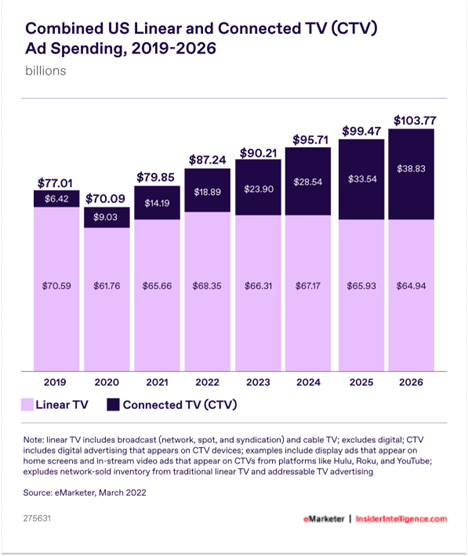
With changing viewer behavior as cable and satellite TV use continue to drop, advertisers are instead following their viewers over to CTV, lured by more measurable ad performance metrics and better-optimized campaign management overall. As linear advertising spend declines, CTV ad spend is fast on the rise.

Ad spending for CTV is expected to reach $21.45 billion in 2024, an increase of 16.2% from 2023. In 2025, it is forecast to hit $24.4 billion, growing year over year by 13.9%.

CTV Advertising vs OTT Advertising

OTT means “Over-the-Top,” referring to content that goes “over” your cable box, providing access to TV content via an internet connection instead of with a cable cord or satellite. While OTT and CTV are often used interchangeably, and can refer to the same thing, it’s important to note that OTT is how video content is delivered to viewers — it can stream content across all devices, like mobile and desktop. CTV only streams content onto smart TV screens, which is why it is often referred to as streaming TV advertising.

OTT ad inventory tends to differ from CTV, which typically has premium network content similar to what you would find on traditional TV. In contrast, OTT offers a much wider range of inventory.

So, Why Use CTV ads?

If you want your ads to help you find users who actually want your products or services, CTV ads are the way to go. As streaming services like Hulu and Netflix adjust their pricing models to an ad-supported tiered system that displays more ads to folks on less expensive plans and fewer or no ads to those on higher plans, marketers can now zero in on their demographic with far more precision.

Here are a few other perks that come with CTV ads:

  1. Multiple precision targeting methods

With linear TV, targeting is limited to finding shows that best index against ratings — the system network television uses to make programming decisions and to price advertisements. But Nielsens’ typically can only offer broad age and gender demographic metrics, like women 25 – 54 and men 18 – 49. But CTV advertisers can leverage similar digital targeting to Google and Facebook, which means audience segments can be based on everything from income or education level to personal interests and more.

Some of the top CTV targeting options to get familiar with include:

  • Geolocation targeting
  • Contextual targeting
  • Retargeting
  • Time-of-day targeting
  • Lookalike targeting
  1. Hyper-local targeting

With CTV ads, it’s far easier to pinpoint consumers based on their IP address, which means ads can be hyper-localized and served to viewers in far smaller geographic areas than with linear ads. Messaging can be highly customized based on where the viewer is located. For example, a spa with four locations can send the right commercial to the right viewers closest to each location.

  1. High Video completion rates

Superior targeting means that CTV ads are far more likely to be truly relevant to those viewing them—which means they are more likely to be interested in the ad and engage with it until completion. Using automatic content recognition technology, or ACR, CTV providers can provide real-time, second-by-second completion rate data, which helps advertisers hone the effectiveness of their marketing campaigns.

  1. Detailed attribution measurement and accuracy

CTV ads allow advertisers to measure the effectiveness of their brand campaigns more accurately via conversions — they can see who came to the brand’s website and completed a purchase after viewing an ad. With time and increased data, advertisers can learn what creative worked best and which publishers, dates, times, and other factors had the greatest impact on conversions.


BOTTOM LINE
Marketers, if you want to lead your company’s CTV marketing innovation charge but need help figuring out where to start, Creative Circle can provide the talent and build the teams to help you perfectly craft and precisely target your brand to shine on the TV screen. The media landscape is fast evolving — to succeed, it’s important to prime your business to be in step with the times.